Dragon fruit went from a curiosity in Kathmandu's premium supermarkets a decade ago to a year-round staple in 2026. The flesh is mild, the seeds are crunchy, and the skin makes for striking presentation — but the variety, ripeness, and origin differences are real and worth knowing before you buy. Below is what we've learned sourcing dragon fruit weekly for our Kathmandu customers.
What dragon fruit actually is
Dragon fruit (also called pitaya or pitahaya) is the fruit of several species in the Hylocereus and Selenicereus cactus genera. Originally from Central and South America, it's now grown commercially across Vietnam, Thailand, China, and increasingly in tropical pockets of South Asia, including Nepal's Terai.
The fruit's dramatic appearance — bright pink or yellow skin with green leaf-like scales — gave it the dragon name. The flavor inside is much milder than the appearance suggests: most varieties have a subtle, slightly floral sweetness similar to a cross between kiwi and pear.
Three varieties, real differences
White-flesh dragon fruit (pink skin)
The most common variety in Nepal. Bright pink skin with white flesh dotted by tiny black seeds. Mildly sweet, mostly neutral flavor. Year-round availability.
Red-flesh dragon fruit (pink skin)
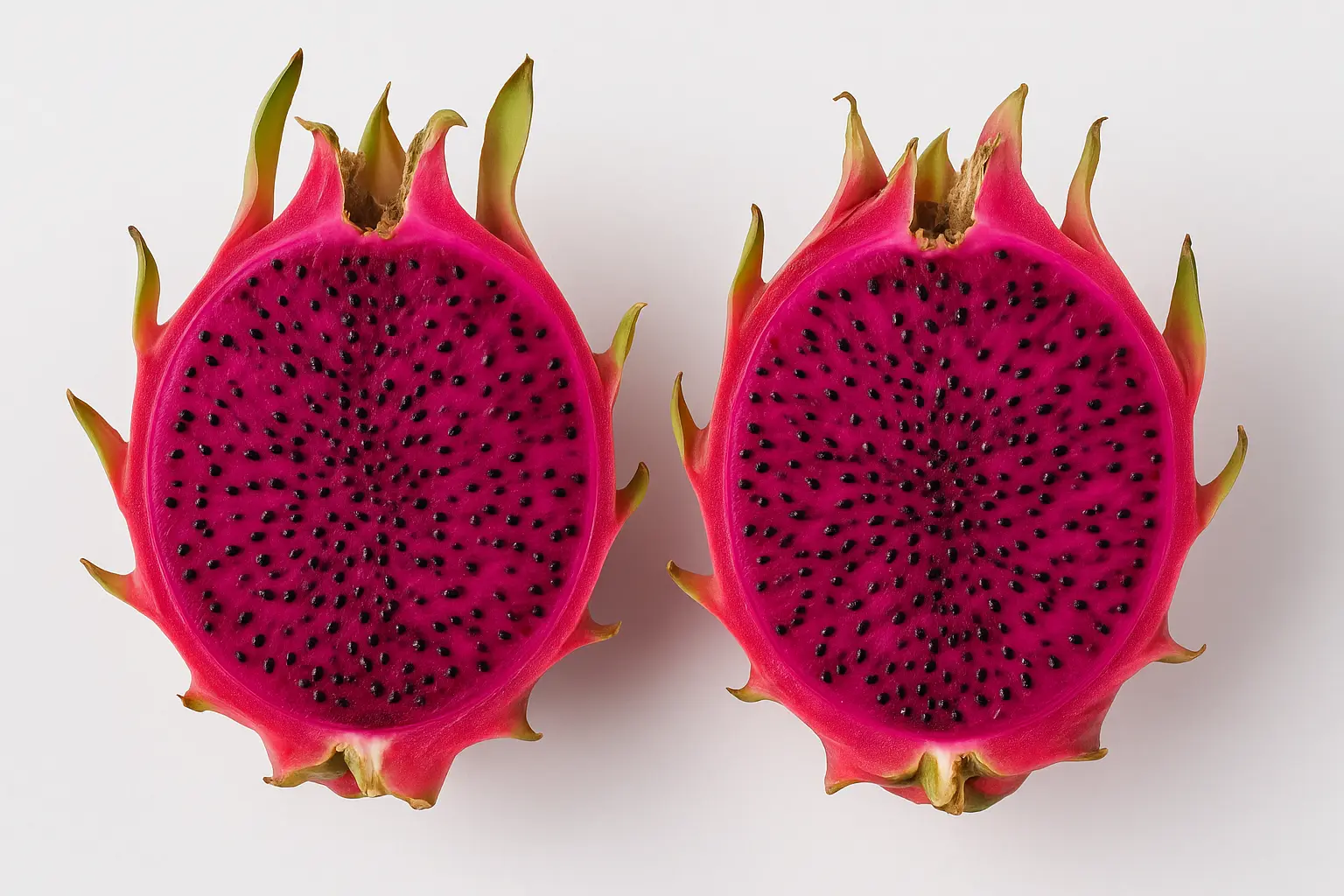
The premium variety. Same pink skin from outside, but inside the flesh is deep magenta. Significantly sweeter and more flavorful than white. Creates dramatic color in smoothies and bowls. Availability is limited and seasonal in Nepal.
Yellow dragon fruit (yellow skin, white flesh)
Rarely available in Nepal. The sweetest of the three. Yellow skin with white flesh. When you see it, it's usually a short window from a Vietnam or Colombia shipment.
| Variety | Flavor | Availability in Nepal | 2026 price (per piece) |
|---|---|---|---|
| White flesh / pink skin | Mild, slightly sweet | Year-round | Rs. 300 – 450 |
| Red flesh / pink skin | Sweeter, more aromatic | Limited, often seasonal | Rs. 450 – 600 |
| Yellow skin / white flesh | Sweetest, most floral | Rare | Rs. 500 – 800 |
- Flavor
- Mild, slightly sweet
- Availability in Nepal
- Year-round
- 2026 price (per piece)
- Rs. 300 – 450
- Flavor
- Sweeter, more aromatic
- Availability in Nepal
- Limited, often seasonal
- 2026 price (per piece)
- Rs. 450 – 600
- Flavor
- Sweetest, most floral
- Availability in Nepal
- Rare
- 2026 price (per piece)
- Rs. 500 – 800
Nutritional profile (USDA)
Reference values per 100 g of fresh dragon fruit, based on USDA FoodData Central:
| Nutrient | Per 100 g | Notes |
|---|---|---|
| Calories | ~60 kcal | Low calorie density |
| Carbohydrates | ~13 g | Includes ~8 g sugar, ~3 g fiber |
| Fiber | ~3 g | ~12% daily value |
| Protein | ~1.2 g | Modest |
| Vitamin C | ~3 mg | ~3% daily value (modest) |
| Iron | ~0.7 mg | ~4% daily value |
| Magnesium | ~18 mg | ~4% daily value |
| Betalains (red flesh only) | — | Antioxidant pigments; not in white flesh |
- Per 100 g
- ~60 kcal
- Notes
- Low calorie density
- Per 100 g
- ~13 g
- Notes
- Includes ~8 g sugar, ~3 g fiber
- Per 100 g
- ~3 g
- Notes
- ~12% daily value
- Per 100 g
- ~1.2 g
- Notes
- Modest
- Per 100 g
- ~3 mg
- Notes
- ~3% daily value (modest)
- Per 100 g
- ~0.7 mg
- Notes
- ~4% daily value
- Per 100 g
- ~18 mg
- Notes
- ~4% daily value
- Per 100 g
- —
- Notes
- Antioxidant pigments; not in white flesh
The marketing language around dragon fruit's nutritional profile sometimes oversells. It's a moderately nutritious fruit, not a miracle. The most defensible claims are around fiber (genuinely useful at 3 g per 100 g) and betalain antioxidants in red-flesh varieties (a real difference from white flesh).
2026 prices in Kathmandu
- White-flesh: Rs. 300 – 450 per piece (medium-sized fruit, ~350–500 g).
- Red-flesh: Rs. 450 – 600 per piece.
- Yellow: Rs. 500 – 800 per piece when available.
- Bulk pricing: Buying multiple pieces from the same supplier typically saves 5–10%.
How to select and ripen
Selection rules that actually work:
- Skin color: Even, bright pink or yellow without large brown patches.
- Scale tips: Green tips indicate freshness. Brown tips mean overripe; the fruit may still be edible but won't hold.
- Pressure test: Ripe fruit gives slightly to gentle pressure (like a ripe avocado). Hard fruit needs another day at room temperature.
- Weight: Heavier feels are denser and usually higher quality.
- Avoid: Soft mushy spots, large dark blemishes, or skin that has lost color.
How to cut and eat it
Two common approaches:
Halve and scoop
- Cut the fruit in half lengthwise.
- Use a spoon to scoop the flesh out — it separates cleanly from the skin.
- Eat as is or slice into cubes.
Peel and slice
- Cut off both ends.
- Score the skin lengthwise into quarters.
- Peel the skin away — it lifts off easily.
- Slice the flesh into rounds or cubes for plating.
The seeds are edible and contribute texture. Don't try to remove them.
Storage in Nepal
- Unripe: Leave at room temperature. Refrigerating halts ripening.
- Ripe: Refrigerate. Use within 5–7 days.
- Cut fruit: Store in an airtight container in the refrigerator. Consume within 2 days.
- Freezing: Cube the flesh and freeze in a single layer, then bag. Frozen dragon fruit is excellent for smoothies; quality holds about three months.
Practical ways to use it
- Fresh and chilled: The simplest way. Halve, chill, eat with a spoon.
- Smoothie bowls: Frozen red-flesh dragon fruit blended with banana and a splash of milk produces the bright magenta base. Top with granola and fruit.
- Fruit salads: Cube and combine with mango, kiwi, and a squeeze of lime.
- Yogurt parfait: Layer cubed dragon fruit with thick yogurt and honey.
Where dragon fruit grown for Nepal actually comes from
The dragon fruit on Kathmandu shelves arrives from a few dominant origins, each with its own characteristics:
- Vietnam (Binh Thuan, Long An): The largest global exporter. Most white-flesh dragon fruit imported to Nepal is Vietnamese. Quality is generally consistent; transit time to Kathmandu adds days to the post-harvest window, so cold-chain handling matters.
- Thailand: Smaller volumes than Vietnam. Often firmer fruit with slightly better travel performance.
- India (Gujarat, Maharashtra, Karnataka): Cultivation has expanded sharply. Indian-grown dragon fruit now reaches Kathmandu in season at competitive prices, though variety control is less strict.
- Nepal (Terai pilot farms): Small commercial cultivation in lowland districts has begun. Quality is variable — some excellent, some unripe-harvested. Worth buying when you can verify the farm.
Common myths worth ignoring
Marketing language around dragon fruit has gotten ahead of the evidence. Three claims to take with skepticism:
- “Dragon fruit fights cancer.” The betalain antioxidants in red-flesh dragon fruit have been studied in cell-culture experiments; there is no credible human evidence supporting any cancer claim. It's a healthy fruit, not a treatment.
- “Dragon fruit lowers blood sugar dramatically.” Some animal studies suggest modest effects on blood glucose; human data is thin and inconsistent. Diabetic-friendly because it's low glycemic, but not a blood-sugar drug.
- “Dragon fruit boosts immunity.” It contains some Vitamin C, but at 3 mg per 100 g, far less than a slice of lemon, kiwi, or guava. There is no mechanism by which dragon fruit specifically “boosts immunity.”
The honest case for dragon fruit: it's low-calorie, modestly fibrous, visually distinctive, and pleasant to eat. That's enough.
Notes on dietary fit
- Diabetic-friendly: Low glycemic load and high fiber make dragon fruit a sensible fruit choice for people managing blood sugar. Pair with protein (yogurt, nut butter) for further glycemic moderation.
- Pregnancy: Safe and beneficial; the iron and folate content is useful in trimesters two and three. No special precautions.
- Children: Soft, mild flavor, easy texture — a good early fruit. Watch for the harmless side effect in red-flesh varieties: betalain pigment can color urine pink or red, which sometimes alarms parents but is not blood and clears in 24 hours.
- Allergies: Rare. A small number of cases of cross-reactivity with kiwi or banana allergy have been reported; people with severe latex-fruit syndrome should try cautiously the first time.
See current dragon fruit listings and our broader fruits catalog. For a wider look at the exotic fruit landscape in Kathmandu, our 2026 exotic fruits guide covers eight categories with prices.
- USDA FoodData Central — Dragon fruit, raw — Nutritional reference values used above.
- NIH PubMed — Betalains and antioxidant activity — Peer-reviewed evidence on red-flesh dragon fruit pigments.